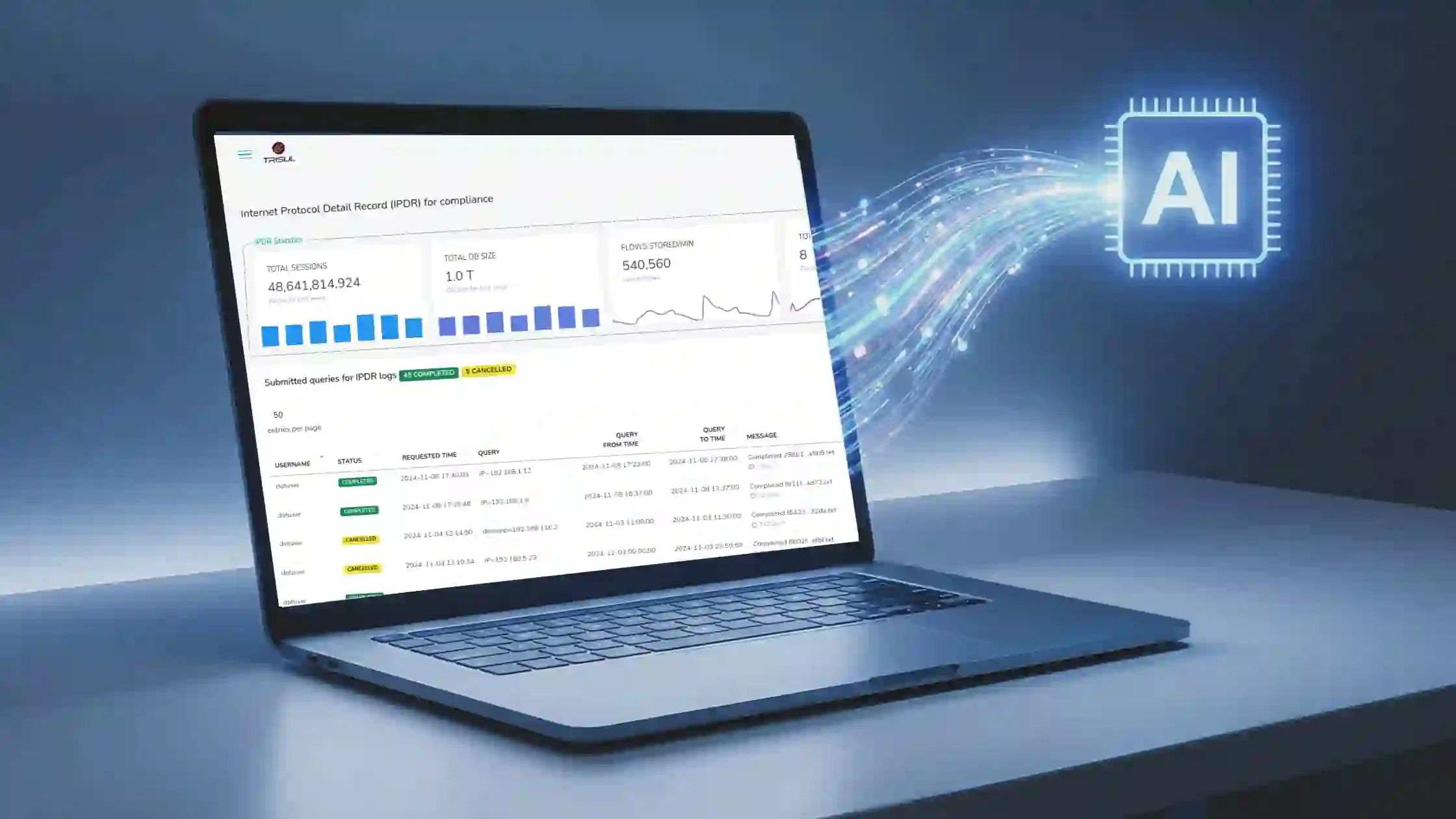
Bringing AI to Audit-Time IPDR Retrieval: Trisul’s 2026 Compliance Model
Earlier, IPDR compliance used to revolve around one thing: Log retention. Over time that evolved into more structured, automated systems that could handle retention, indexing, and massive volumes of data with ease.
But real-world experience has made one thing clear. Compliance success isnt defined by how much data youve saved. Its defined by how confidently and accurately you can pull the exact records you need during an audit under tight timelines without second-guessing the results.
Practical Limitations in Day-to-Day Use
This is where many existing approaches begin to show their limits. Many ISPs still implement compliance through in-house systems built over time, while others rely on agents to manage regulatory formalities.
Both models are sufficient for initial architecture setup, data retention and data collection, they tend to be less efficient in the phase that matters most: the audit itself.
Audit queries typically require precise retrieval of logs within a defined time window. What appears straightforward for new licensees often demands uncompromising accuracy and operational readiness in practice which is something ISPs with prior audit experience understand well.
That’s why IPDR compliance today is moving beyond just storage and collection. IPDR compliance today can be implemented as a fully automated system and owned through a perpetual license, giving ISPs full control without vendor lock-ins.
AI in Support of Audit Readiness
The good news is that, With Trisul IPDR Solution, AI is now enhancing how teams interact with IPDR systems. By enabling access to compliance workflows through natural language, AI removes friction from the the most demanding part of IPDR compliance: Precise audit time retrieval.
Where AI Fits
In Trisul IPDR Solution, AI serves as an access layer and not an analysis engine. Although we all know that AI can do a lot of things, there is a reason it stays on a short leash here. While AI can analyze data, summarize it, spot patterns, and sometimes confidently explain things it barely understands.
That’s exactly why compliance systems need to be careful.
As the IPDR logs are sensitive, there s no room for “mostly right” or “probably fine”. AI’s role is intentionally limited here as audits are unforgiving and even a small security slip can turn into a serious trouble. This concern isn’t limited to users or regulators. Recently, several leaders building large AI systems like Anthropic CEO, Elon Musk have repeatedly warned us about the risks of deploying AI without strict boundaries and controls.
Trisul believes in the same principle and built its solution to make sure all the compliance protocols governing access, retention, and audits remain unchanged.
So, it’s also important to know what AI doesn’t do
Whenever AI enters a compliance conversation, it’s natural to wonder where the boundaries are. So it’s worth being very clear about what the AI in Trisul IPDR Solution is not meant to do.
This AI:
- does not replace lawful interception systems
- does not make compliance or legal decisions
- does not predict criminal behavior
- does not generate synthetic or inferred data
- does not bypass any regulatory or approval process
In short, it doesn’t take over responsibility, judgment, or authority.
All it does is make it easier for humans to interact with an already compliant system. AI just helps reduce the friction involved in getting to the right report, at the right time.
How AI-Assisted Access Works (Behind the Scenes)
In the Trisul IPDR Solution, the AI layer does not sit inside the compliance engine and has no visibility into IPDR data. Its role is strictly limited to improving how users interact with the system.
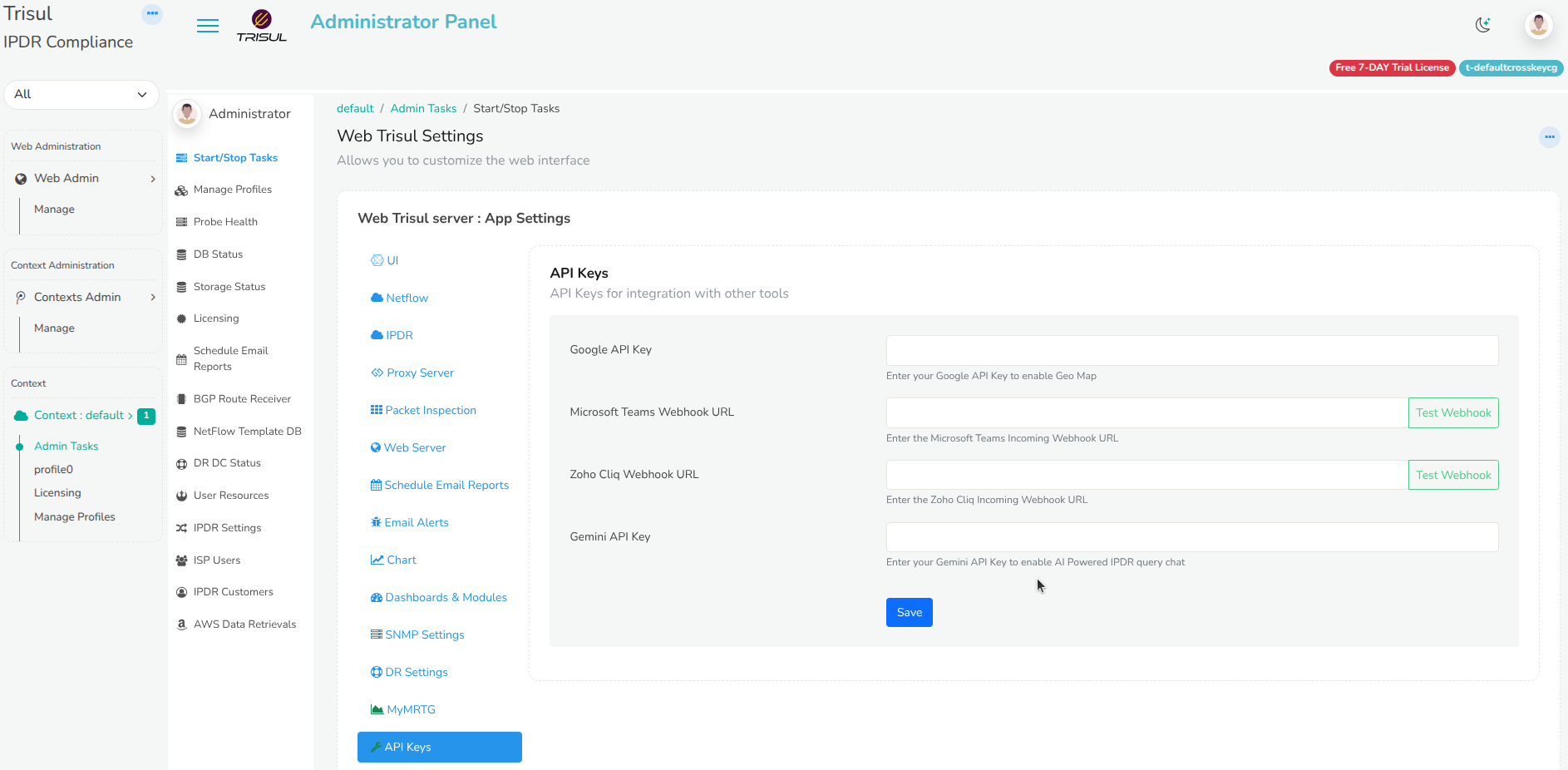
Access begins with authentication. A valid API key is required for the AI layer to process any request. This key is tied to the user’s identity and permissions. Without it, the AI cannot identify the user and does not proceed.
When a user enters a request in plain language, the AI does not search logs or generate reports. Instead, it converts the request into a structured JSON payload. This JSON is then passed to the existing form-based compliance workflow engine, which handles validation, query execution, access control enforcement, and report generation.
The AI layer is not involved beyond this translation step. It does not execute queries, does not influence how results are compiled, and has no access to the retrieved records or the final report output. Its function ends once the structured request is handed off.
In short, the AI helps users communicate with the compliance system, but it never touches the underlying IPDR data or reports. The core compliance workflows remain unchanged, governed, and audit-ready.
Talking to IPDR in Plain Language
With AI assisted access, interacting with Trisul IPDR Solution is just like chatting with your ChatGPT. You can simply explain what you’re looking for, the same way you would during an audit call or an internal discussion.
For example:
- which subscriber or identifier the request is about
- the exact time window involved
- the kind of records that need to be pulled
That’s it.
The system takes what you’ve said and runs the same compliant workflows behind the scenes. Before anything is exported, you can preview the results and make sure they’re correct before the export. So the data doesn’t change. The rules don’t change.
What changes is the effort it takes to get to the right answer.
Practical Impact for ISP Teams
For ISP network and compliance teams, the impact of AI assisted access isnt theoretical. It shows up in very practical ways, especially when an audit or LEA request lands unexpectedly.
– Teams can respond faster during audits because less time is spent figuring out how to frame the query or correcting errors after running it. You simply ask for what you need, review the result, and move forward.
– There’s also less dependence on a few “go-to” experts who remember every field, format, or edge case. Retrieval workflows become easier to execute, even for team members who don’t deal with IPDR systems every day.
– Previewing results before exporting reports cuts down on rework. Instead of downloading, checking, correcting, and repeating, teams can confirm accuracy upfront and generate reports with confidence.
– Since audits occur infrequently, its easy to forget the exact form fields however simple the retrieval process actually is. With AI-assisted access, teams don’t have to “prepare” for an audit the way they would for an exam.
Trisul IPDR solution is purpose built keeping all these details in mind that add up to something that teams value deeply: predictability under pressure.
Closing
Quiet days don’t test compliance systems. Audits do.
That’s why, for teams operating under realworld audit constraints, automation lays the foundation, and AI-assisted access helps ensure that foundation holds up when precision and timing matter most.
This focus on reliability under pressure reflects Trisul’s core belief that trust in compliance systems is built through precision, transparency, and engineering discipline.