2025 Wrap-Up: A Turning Year for Trisul Network Analytics
At some point, every network analytics tool runs into the same moment: Can it keep up when the questions stop being linear?
Answering a single question is no longer the challenge. It’s about whether it can stay with you as the questions change.
Most modern, SaaS-first platforms are excellent at answering individual questions. You frame a query, pick your dimensions, run it, and get a clean result. Want another angle? Pivot. Run again. Each step works exactly as expected.
But investigations don’t usually move in neat, isolated steps.
They branch. They double back. They force you to hold context across dimensions and time. And that’s where friction creeps in. Not because the answers are wrong, but because continuity becomes manual. You remember the path. You restate relationships. You keep the mental map because the system doesn’t.
That’s not a failure. It’s a consequence of how those systems are built.
Trisul took a different route early on.
Relationships between IPs, ASNs, interfaces, applications, subscribers, and flows aren’t assembled on demand. They’re maintained as traffic is processed. The system isn’t constantly re-deriving meaning. It already knows how things relate.
For years, that approach primarily showed up as depth. Power that rewarded patience.
In 2025, something shifted. This was also the year Trisul got AI-fied, making the intelligence already embedded in the system easier to reach.
That same depth began translating into flow. Less rework. Fewer resets. A sense that the system stays with you as questions evolve instead of asking you to rebuild context at every step.
Making Intelligence Reachable
Now layer AI onto this landscape.
Over the past year or two, AI has shown up everywhere in network analytics. And sensibly so. Most platforms use it at the surface: summarizing dashboards, explaining charts, highlighting anomalies, nudging you toward something interesting.
Those are useful capabilities. They reduce noise and speed up orientation.
But you’ll notice something else too.
Very few systems are comfortable letting AI drive deep investigations. Inferring strong correlations or causal paths is risky business when accuracy and defensibility matter. So AI stays advisory. Helpful, but kept on a short leash.
That’s not hesitation. That’s realism.
Trisul entered AI from a very different starting point.
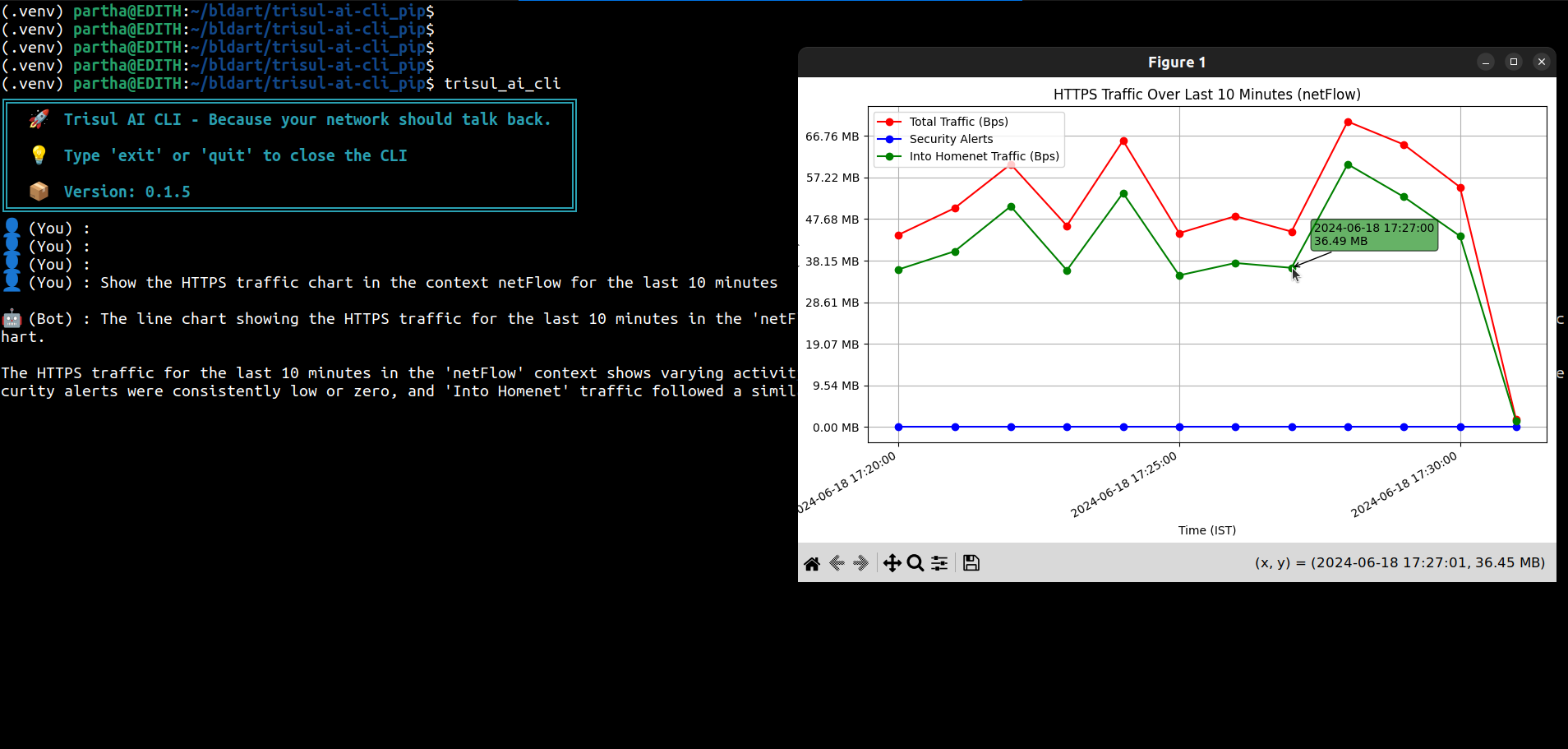
Because the system already maintains its own structure, AI doesn’t need to “figure out” how things connect. The Trisul AI CLI navigates what’s already there. It shortens the distance between intent and answer without inventing meaning along the way.
Think of it less as AI trying to be clever, and more as AI being respectful of the system it’s working with.
You ask better questions faster.
You move through the data more fluidly.
And if you turn AI off, nothing collapses. The system still stands on its own.
That’s not accidental. Trisul restrained that by design.
Multicast as a First-Class System
Across the industry, multicast has mostly been treated as a capability.
It’s something tools support, not something they invest in. You can see multicast traffic. You can measure it. You can confirm it’s there. And for many platforms, that’s considered sufficient.
What rarely gets attention is the user experience around it.
You might see IGMP or PIM events in logs. You can filter, group, and trend it.
When something goes wrong, the workflow looks familiar:
- check which multicast groups are active
- look at sources in one view
- look at receivers in another
- line things up mentally and hope nothing important slips through
The data exists, but the burden of making sense of it falls on the operator. That approach works. It just doesn’t scale well when multicast becomes critical infrastructure.
That changed in 2025.
The Multicast Graph didn’t add new multicast intelligence.
Multicast has always been visible in Trisul. Trisul just made existing structure visible
Because Trisul already preserved relationships between multicast sources, groups, receivers, and flows, the graph could present multicast as a connected system instead of a collection of fragments. What operators had previously inferred across tables could now be seen directly.
The difference is practical:
- multicast behavior is visible as a whole
- relationships don’t need to be reconstructed during investigation
- changes in topology stand out immediately
This isn’t a visualization trick.
It’s the result of surfacing structure that had already been there.
And once multicast is seen this way, it stops feeling like a special case and starts behaving like a system you can reason about.
Crosskey Tree: When Exploration Loses Its Shape
Multicast is one example of a broader pattern you start noticing once investigations get real.
The moment you move past single lookups and begin exploring the network as a system, the questions stop lining up neatly. You follow one lead, then branch into another. You narrow scope, widen it again, switch dimensions, adjust time ranges. That’s not edge-case behavior. That’s normal investigation.
This is also where friction quietly creeps in.
You begin with a clear question. You pivot once. Then again. Maybe you move from IPs to ASNs, from applications to interfaces, from flows to counters. Each result is correct. Each view makes sense.
And yet, after a few steps, you pause.
How exactly did this view connect to the previous one?
Nothing is broken. The system is responding exactly as designed. But the path you took is no longer visible. Context is still there, just no longer carried forward.
In query-first analytics platforms, investigation is typically built around independent views.
Each pivot produces a new query. Filters may carry over, but investigative context does not persist as a structure. The system answers the current question well, but treats it as a self-contained interaction.
To maintain continuity, users compensate manually:
- remembering which filters led here
- reconstructing earlier views to compare
- opening multiple tabs to hold context
- relying on saved queries or dashboards as anchors
Some platforms add breadcrumbs. Some emphasize timelines. Some recommend standard investigation workflows.
These help with navigation, but they don’t change the underlying behavior. Each step still resets the frame. Continuity lives in the user’s head, not in the system.
That approach scales fine for shallow exploration but becomes fragile as investigations deepen.
IPDR Beyond One-Off Queries
IPDR always sounds simple on paper.
A request comes in. You extract records. You deliver results. Done.
In reality, it’s repetitive, procedural, and unforgiving. Subnets instead of single IPs. Follow-ups that slightly change scope. Multiple requests landing at once. Zero tolerance for gaps or mistakes.
That’s why many teams never productize IPDR properly. They script it.
The hidden cost of scripts
In-house scripts feel efficient at first. Until volume grows.
Logic diverges. Audits get messy. Parallel requests become coordination problems. Confidence starts depending on who ran the script, not what the system guarantees.
Nothing breaks loudly. Everything just becomes fragile.
Even when IPDR exists inside a product, it’s often treated the same way: one query at a time. Export, repeat, stitch results outside the system. The data lives in the tool. The workflow doesn’t.
How Trisul Approached
Trisul treated IPDR as a workflow that has to survive repetition and scrutiny.
Subnet-based IPDR queries made subnets a first-class scope, removing manual expansion. Support for multiple IPDR queries in a single upload removed forced serial execution and reduced bookkeeping.
In 2025, IPDR volume and expectations increased. The cost of brittle scripts and one-off queries became visible.
Years of working inside telecom environments exposed the hidden friction in IPDR workflows: the repetition, the follow-ups, the coordination gaps that never show up in specifications. Those lessons shaped how IPDR works in Trisul today.
And that’s what makes Trisul a steady reference point in a space where most solutions stop short.
Looking Ahead, Without Changing Course
If there’s a pattern running through everything that surfaced this year, it’s not acceleration. It’s alignment.
The AI CLI, the Multicast Graph, the Crosskey Tree, the IPDR workflow improvements. None of these exist because Trisul decided to chase a trend or fill a checklist. They exist because the system had already been built with structure, continuity, and correctness in mind.
This was the point where that groundwork became obvious in daily use.
As networks stretch across clouds, edges, ISPs, and encrypted protocols, the cost of shallow answers and fragile workflows keeps rising. Tools that optimize for speed alone eventually run out of room. Tools built around structure age differently.
Trisul’s direction hasn’t changed. What changed is how clearly that direction shows up in everyday use.
2025 mattered because Trisul became easier to operate at scale, without becoming simpler underneath.
With that foundation in place, here’s to the year ahead.
