
Modern Security Operations Centers (SOCs) face a growing challenge.
Networks are larger, traffic is increasingly encrypted, applications are distributed across data centers and cloud environments, and attackers are constantly finding new ways to blend into legitimate activity.
The result?
More alerts. More anomalies. More uncertainty.
While traditional monitoring tools can tell you that something unusual happened, they often struggle to answer the question analysts care about most:
What happened, why did it happen, and does it require action?
This is where Network Behavior Analysis and Detection (NBAD) becomes critical.
And with the release of Trisul 8.0, we’re excited to introduce Trisul NBAD. Built on Trisul’s deep traffic visibility and packet analytics foundation, Trisul NBAD brings together behavioral monitoring, anomaly detection, Layer 7 visibility, traffic investigation, and threat analytics into a unified platform designed for modern SOC teams.
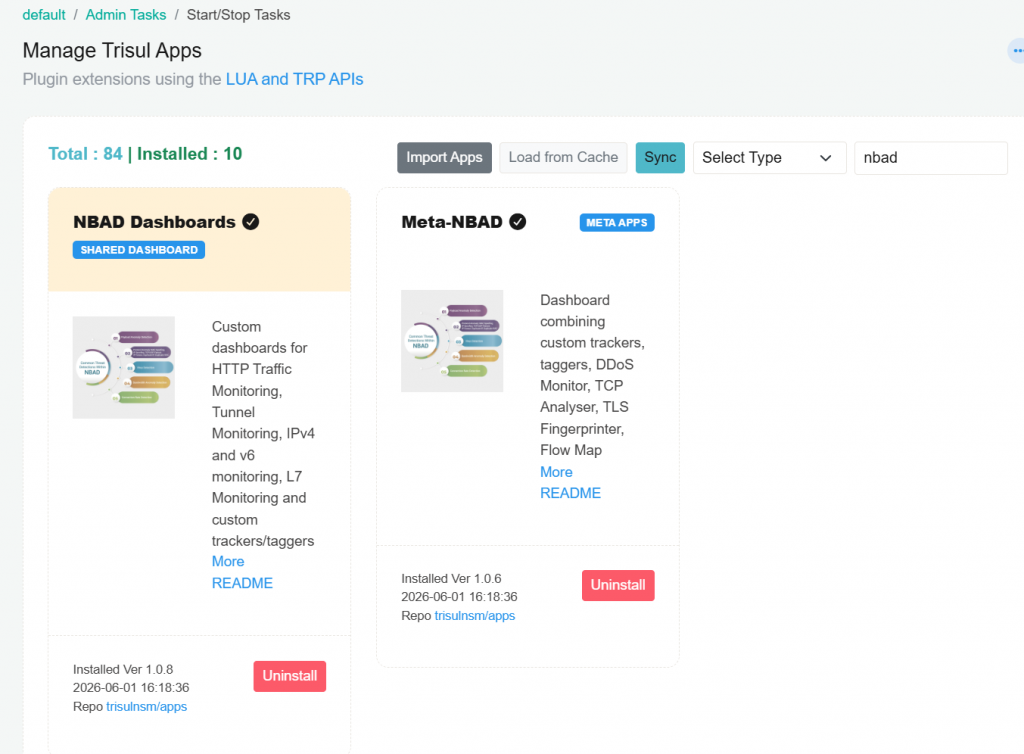
To get started with Trisul NBAD, simply install the Meta NBAD application package from Trisul Apps. This package provides access to a collection of traffic monitoring, behavioral analysis, and detection dashboards that can be accessed directly from the NBAD menu. For detailed installation and configuration instructions, refer to the Trisul NBAD documentation:Trisul NBAD Documentation
Yet detection is only one part of the equation. Every security tool can generate alerts. What separates an effective NBAD platform from the rest is its ability to provide the context, visibility, and evidence needed to understand those alerts and act on them with confidence.
What is Network Behavior Analysis and Detection (NBAD)?
Network Behavior Analysis and Detection (NBAD) is a security approach that continuously monitors network activity, establishes a baseline of normal behavior, and identifies deviations that may indicate threats, operational issues, or policy violations.
Unlike traditional signature-based systems that focus on known threats, NBAD focuses on behavior.
This allows organizations to detect:
- Traffic anomalies
- DDoS attacks
- Unusual communication patterns
- Unauthorized applications
- Peer-to-peer traffic
- Suspicious encrypted communications
- Network misuse
- Performance degradation
Instead of asking:
“Does this match a known threat signature?”
NBAD asks:
“Why is this system behaving differently from normal?”
The Problem with Traditional NBAD Solutions
Many organizations invest in NBAD expecting improved visibility and faster threat detection.
While most solutions are effective at generating alerts, security teams often discover that detection is only the beginning of the investigation.
1) Detecting an Anomaly Is the Easy Part
Modern NBAD solutions are very good at identifying unusual behavior.
They can tell you:
- A host is behaving differently
- Traffic suddenly increased
- An application is generating unusual connections
- A communication pattern changed
But an anomaly is not an incident.
It is simply the starting point of an investigation.
The real challenge is understanding:
- What changed?
- Which systems are involved?
- Which applications are responsible?
- Is it malicious, operational, or expected?
Without context, anomaly detection quickly turns into alert fatigue.
2) Too Many Tools, Not Enough Answers
A typical investigation workflow often looks like this:
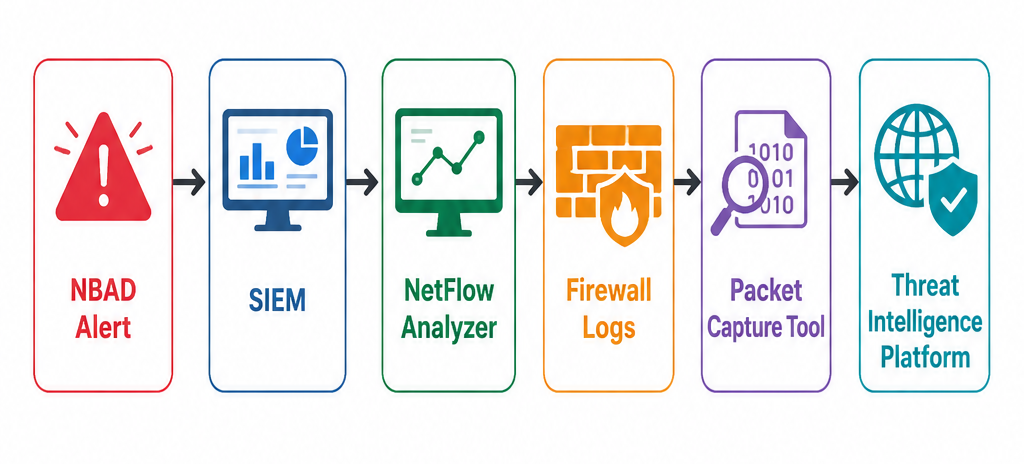
By the time an analyst understands what happened, valuable investigation time has already been lost.
Security teams don’t need more alerts.
They need faster answers.
3) Flow Data Doesn’t Tell the Whole Story
Many NBAD solutions rely heavily on:
- NetFlow
- IPFIX
- sFlow
Flow records are excellent for identifying communication patterns, but they often lack application context.
An analyst may see:
10.1.1.10 → 203.0.113.5
TCP/443
But that still doesn’t answer:
- Which application generated the traffic?
- Which website or service was accessed?
- Was it expected?
- Is it suspicious?
Without additional visibility, analysts are left guessing.
4) Encrypted Traffic Creates Visibility Gaps
Today, the majority of network traffic is encrypted.
Traditional monitoring tools may only reveal:
- Source IP
- Destination IP
- Port numbers
But modern investigations require more context.
Security teams need visibility into:
- Application behavior
- TLS communications
- Requested hostnames
- Certificate authorities
Without decrypting traffic.
5) Not Every Anomaly Is a Security Incident
Security teams frequently investigate events that turn out to be:
- Backup jobs
- Software updates
- Cloud synchronization
- Misconfigurations
- Performance issues
A latency problem can look like a security problem.
A network issue can look like malicious activity.
Without performance visibility, analysts waste valuable time chasing false leads.
How Trisul NBAD Is Different
Trisul NBAD was designed around a simple principle.
Detection without investigation creates more work for security teams
Rather than focusing only on anomaly detection, Trisul combines traffic visibility, behavioral analytics, protocol intelligence, and investigation workflows in a single platform.
The result is a workflow that starts with detection and ends with evidence.
Layer 7 Visibility Beyond Basic Flow Records
Trisul provides deep visibility into application layer activity through dashboards such as:
- Layer 7 Metrics
- HTTP Traffic Analytics
- IPv4/IPv6 Monitoring
- Tunnel Analytics
This allows analysts to understand:
- Which applications are active?
- Which services are being accessed?
- Which hostnames are involved?
- How encrypted traffic is behaving?
The Layer 7 Metrics Dashboard provides visibility into
- Application
- TLS Root Certificate Authorities
- Intermediate Certificate Authorities
- Server Name Indication
This helps analysts understand encrypted traffic without requiring traffic decryption.
Detection Built Around Real Network Behavior
Trisul includes dedicated dashboards designed to identify suspicious or abnormal activity.
Stable Keys and ShiftX: Behavioral Analytics in Action
One of the core principles of NBAD is understanding how network behavior changes over time.
Trisul approaches this through two complementary analytics engines:
Stable Keys
Imagine monitoring traffic in a busy city. Every day, thousands of vehicles enter and leave, but certain roads consistently carry the majority of traffic.
Stable Keys helps identify these consistently important entities within the network. By tracking hosts, applications, and communication patterns that remain significant over time, analysts can establish reliable baselines and quickly recognize deviations from normal behavior.
ShiftX
Now imagine that one of those major roads suddenly becomes empty while a previously quiet street experiences a surge of traffic.
That change itself may be more important than the actual traffic volume.
ShiftX is designed to identify these behavioral shifts by highlighting significant changes in network activity compared to historical patterns. This allows analysts to detect emerging issues, suspicious activity, and operational anomalies that may otherwise go unnoticed.
Together, Stable Keys and ShiftX help SOC teams move beyond simple traffic monitoring and begin understanding how network behavior evolves over time.
DDoS Metrics
DDoS Metrics dashboard provides visibility into:
- DNS amplification traffic
- NTP amplification traffic
- SSDP abuse
- ICMP anomalies
- Ingress vs egress traffic ratios
- TCP vs UDP behavior
Imagine you’re responsible for monitoring a city’s road network.
Under normal conditions, traffic flows predictably between neighborhoods, business districts, and highways. If thousands of vehicles suddenly begin converging on a single location from all directions, traffic controllers immediately recognize that something is wrong.
The DDoS Metrics dashboard works in a similar way. It continuously monitors network traffic patterns and highlights abnormal surges, amplification behavior, and unusual traffic ratios that often indicate denial-of-service attacks.
Instead of waiting for applications or websites to become unavailable, SOC teams can identify suspicious traffic behavior early and investigate the source before the attack causes disruption.
The second version fits better with the rest of the blog because you’ve already been talking about traffic patterns and behavior. It reinforces the core NBAD message:
It’s not just detecting attacks. It’s recognizing when traffic starts behaving differently from normal.
TCP Analyzer
Not every anomaly is a cyberattack.
Sometimes the problem is simply a network struggling to do its job.
The TCP Analyzer dashboard helps identify:
- Retransmissions
- Latency
- Timeouts
- Poor-quality flows
Think of it like listening to a phone call. Networks behave in much the same way.
When packets are lost, delayed, or arrive out of order, systems must retransmit data, wait longer for responses, and retry failed communications. To an application, this can look like slowness, instability, or even complete service disruption.
The TCP Analyzer dashboard helps SOC and network teams identify these symptoms before they escalate into larger operational problems.
This operational context is critical because performance issues often generate the same symptoms as security incidents. By monitoring connection quality, retransmissions, and latency, analysts can quickly determine whether an alert is the result of malicious activity or simply a network struggling under load.
DNS and TCP SYN Flood Detection
Dedicated flood-monitoring dashboards help identify:
- DNS floods
- TCP SYN floods
- Bandwidth spikes
- Connection anomalies
A DNS flood overwhelms a service with an excessive number of DNS requests, while a TCP SYN flood overwhelms systems by initiating thousands of connection requests without completing them.
The DNS and TCP SYN Flood dashboards help analysts spot these abnormal traffic patterns early by monitoring sudden spikes in requests, connection activity, and bandwidth consumption. This allows security teams to investigate potential attacks before services become unavailable.
P2P Analytics
The P2P Analytics dashboard provides visibility into:
- BitTorrent
- Tor
- Gnutella
- eMule/eDonkey
Helping organizations identify:
- Unauthorized file sharing
- Shadow IT
- Bandwidth abuse
- Anonymized communications
Instead of connecting through a central server, devices communicate directly with one another. While this technology has legitimate uses, it is also commonly associated with file-sharing applications, anonymization networks, and software that may violate organizational policies.
The P2P Analytics dashboard helps security teams identify these communication patterns by highlighting peer-to-peer protocols, anonymized traffic, and unusual bandwidth consumption. This visibility allows organizations to detect shadow IT, investigate unauthorized applications, and understand how traffic is moving across the network.
Investigation Without Leaving the Platform
This is where Trisul NBAD truly stands apart.
Most dashboards allow analysts to drill directly into:
- Traffic Charts
- Long-Term Reports
- Flow Analysis
- Edge Graphs
- Statistical Analysis
- Packet Capture Downloads (PCAP)
Instead of moving between multiple products, analysts can investigate suspicious activity from the same platform where it was detected.
This dramatically reduces investigation time and provides immediate context around alerts and anomalies.
Built for Existing SOC Workflows
Trisul integrates naturally into existing security operations environments.
NetFlow/IPFIX Generation
Using the NFGEN application, Trisul can generate and export:
- NetFlow v5
- NetFlow v9
- IPFIX
- JSON Flow Records
allowing organizations to integrate with existing monitoring and analytics platforms.
SIEM Integration
Alerts can be forwarded through Syslog to external SIEM platforms, including:
- Splunk
- QRadar
- Elastic
- ArcSight
This enables centralized alert correlation while retaining access to Trisul’s deep traffic visibility and investigation capabilities.
Why SOC Teams Choose Trisul NBAD
Every network generates anomalies. Not every anomaly is a threat.
The challenge for SOC teams is determining which events matter, why they happened, and how quickly they can be investigated. Most NBAD solutions focus on the first part of the problem: detection.
Trisul focuses on the entire workflow.
From Layer 7 visibility and traffic monitoring to DDoS detection, P2P analytics, flow investigation, edge graphs, and packet-level evidence, Trisul helps analysts move from observation to understanding without constantly switching tools.
Because in modern security operations, the goal is not to generate more alerts.
It is to reduce uncertainty.
Most NBAD solutions tell you that something unusual happened.
Trisul helps you understand what happened, why it happened, and what to do next.